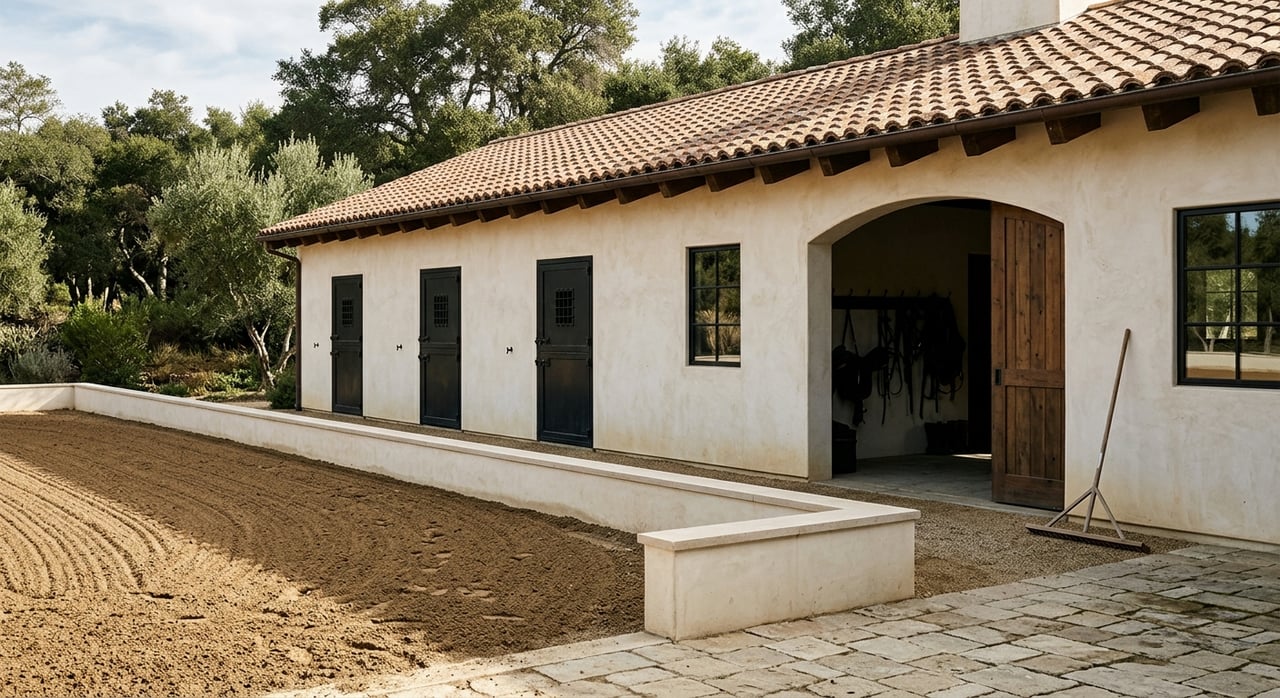
How to Evaluate Rancho Santa Fe Equestrian Properties
Shelly O'Neil April 2, 2026
Shelly O'Neil April 2, 2026
If you're searching for a horse property in Rancho Santa Fe, you already know that not every large lot works the way it looks on paper. A parcel may appear ideal online, yet the real test is how well it supports day-to-day horsekeeping, trail access, circulation, and approvals. This guide will help you focus on what equestrian buyers actually look for in Rancho Santa Fe properties, so you can evaluate opportunities with more clarity and confidence. Let’s dive in.
Rancho Santa Fe has a long-standing equestrian identity that goes beyond marketing language. According to the County of San Diego, the area is part of a low-density estate-residential community with a rural character, typically built on two-acre or larger lots, and Rancho Santa Fe is the historic focus of that larger plan area. The County also notes that horse ownership and equestrian activity are an essential part of local lifestyle and trail planning in the region.
That context matters when you shop for property here. In the Covenant of Rancho Santa Fe, estate-scale land use often shapes buyer expectations more than a standard suburban idea of lot size. The Covenant itself spans about 6,720 acres with roughly 1,900 residential building sites, which helps explain why buyers often prioritize layout, trail connectivity, and usable land over simple square-foot totals.
For many buyers, the appeal is not just the home. It is the combination of privacy, land, and access to a horse-oriented environment that is already woven into the community fabric.
One of the biggest mistakes equestrian buyers make is assuming total lot size tells the full story. In practice, usable acreage matters far more than the headline number in the listing.
The County defines usable area as the part of the property actually used by horses, including barns, arenas, corrals, stalls, and paddocks. It does not include areas such as driveways, parking areas, residences, landscaping, or road easements where horses are not kept. You can review that definition in the County’s zoning ordinance.
This means a property with a large gross lot may still have limited equestrian function. If you want a barn, turnout space, trailer parking, and easy circulation, the right question is not "How big is the parcel?" It is "How much of this land is truly usable for horses?"
When equestrian buyers tour Rancho Santa Fe properties, they usually look at:
These practical details often determine whether a property feels effortless to use or complicated from day one.
Even when a parcel feels horse-friendly, placement rules can affect what you can build or expand. County setback requirements are especially important if you are planning a stable, enclosure, or arena improvements.
Under County rules, horse-stable structures over 1,000 square feet must meet standard setbacks plus a 25-foot setback from all property lines. On lots under 5 acres, horse-stable enclosures and related structures must also be at least 50 feet from the nearest adjacent residence, as outlined in the same County zoning ordinance.
For you as a buyer, that means layout matters as much as land size. A beautiful parcel with narrow building envelopes, nearby neighboring homes, or awkward easements may not support the horse setup you have in mind.
Horse property is about movement, not just structures. The San Dieguito Community Plan states that road design should account for equestrian rigs and that equestrian trails should be separated from motorized traffic where possible. In everyday terms, buyers want a property where horses, equipment, and trailers can move through the site without tight turns, bottlenecks, or dead-end awkwardness.
That is one reason experienced equestrian buyers pay close attention to driveway width, gate access, trailer approach, and whether the site feels efficient to operate on a regular basis.
In Rancho Santa Fe, trail access is often one of the biggest reasons buyers target specific properties. The Rancho Santa Fe Association says the Covenant includes nearly 60 miles of private equestrian and pedestrian trails for residents and their guests, with many sections wide enough for two riders side by side.
That kind of access can shape your day-to-day experience in a meaningful way. Instead of trailering out for every ride, you may be able to ride directly from your property or connect quickly into the network, depending on the parcel and its location.
Buyers should also understand that trail access is not the same everywhere. A key question is whether a property is inside the Covenant or in a surrounding Rancho Santa Fe-area subdivision with different rules, access patterns, or governing documents.
The trail system is not just a map feature. The Association’s trail rules make clear that horses have the right-of-way, motorized vehicles are not allowed, and users are expected to stay on trails and respect nearby property owners.
For equestrian buyers, this reinforces something important: Rancho Santa Fe offers not only horse infrastructure, but also a horse-aware community environment. That can be a meaningful advantage if you want a setting where equestrian use is already understood and supported.
One of the most important distinctions in Rancho Santa Fe is whether a property is inside the Covenant or outside it. Buyers often use the name Rancho Santa Fe broadly, but the County makes clear that the Covenant is a defined private community, and that several surrounding perimeter communities may share estate-residential traits while operating under their own CC&Rs and review processes.
That distinction can affect everything from trail rights to design review to future property improvements. Within the Covenant, the County says the Protective Covenant sets detailed building, land-use, and subdivision requirements. The Rancho Santa Fe Association also states that exterior changes are reviewed by the Art Jury and Building & Planning Department to help preserve community style and quality.
So if you are comparing two similar-looking estates, the governing framework may be very different. One property may offer private trail access and a certain review process, while another may fall under separate restrictions or approvals.
Another major consideration is whether your intended horse use is private or commercial. The County’s zoning FAQ for horsekeeping and horse stables distinguishes between the private use of horses by owners or occupants and commercial horse-stable operations.
In general, the County says private horsekeeping is allowed on most properties without a permit, while commercial horse stables are treated differently. For commercial uses in applicable zones, the County uses a tiered permit structure tied to horse count and usable acreage, with requirements becoming more involved as operations increase in intensity.
This matters because a property can seem ideal for horses while still having limits tied to zoning, usable-area calculations, setbacks, easements, or Covenant review. If you are considering boarding, lessons, or a more active equestrian setup, parcel-specific verification is essential before you assume a use will be allowed.
Before you move forward on a Rancho Santa Fe horse property, it helps to confirm these items in order:
The County notes that some horse-stable projects may require building and grading permits in addition to zoning review. That is why many careful buyers start with zoning confirmation, then review governing documents, then bring in the right site and building professionals.
In Rancho Santa Fe, luxury presentation matters, but equestrian buyers usually think beyond the house itself. A polished residence is important, yet the horse component often carries equal weight in the decision.
Buyers tend to favor properties where the equestrian improvements feel integrated and practical. That may include convenient barn access, room for feed and equipment storage, trailer-friendly entry, safe horse circulation, and enough separation to keep the site comfortable for both household living and stable activity.
Drainage and manure management are also not small details. County guidance says runoff from horse and livestock activity must remain on the property, manure should be stored away from drainage areas and covered or bermed, and horse stables must have manure management, fire protection, and vector control plans. These elements directly affect how easy a property is to maintain over time.
For buyers trying to understand what horse-oriented living can look like in the Covenant, the Rancho Santa Fe Association’s description of Osuna Ranch is a useful local example. The 27-acre property includes a working equestrian facility, horse boarding, grazing, two arenas, and access to the Covenant trail network.
You may not be looking for a property on that scale, but it illustrates the broader local standard. In Rancho Santa Fe, equestrian value often comes from the relationship between land, infrastructure, and trail connectivity, not just from a single amenity like a barn.
The County’s current Rancho Santa Fe road project reflects that same reality, with pedestrian and equestrian crosswalks and a 10-foot-wide equestrian trail connection planned as part of transportation improvements. That kind of planning signals that horse use remains an active, visible part of local life.
If you are serious about an equestrian property in Rancho Santa Fe, the best questions are usually the practical ones.
Ask whether the parcel is inside the Covenant or outside it. Ask whether horsekeeping is already allowed as intended, whether there is enough usable area for your setup, and whether trail rights are private, shared, or member-only.
You should also ask how the site handles drainage, where manure storage would go, whether trailers can move through the property easily, and what approvals would be needed for any future improvements. Those answers often tell you more than photos ever will.
If you want guidance evaluating Rancho Santa Fe horse properties with a local, detail-oriented lens, The O'Neil Group can help you compare options, ask the right questions early, and move forward with greater confidence.
San Diego Real Estate Market
The latest San Diego housing market data reveals what every homeowner should know about inventory, home prices, buyer demand, and whether now is the right time to sell.

Real Estate
We're excited to connect with you and help you achieve your real estate goals. Whether you have questions about buying, selling, or investing, or you simply want to learn more about our services, we're here to provide the information and guidance you need. Let's connect today!